Formula Car Gear Circuit

VT Shift Circuit ConnectionsMy brother is senior at Virginia Tech and is a memeber of the VT Formula SAE team which designs and builds vehicles for national competitions.  This week he told me the driver was having a difficult time managing the car and knowing what gear they were in.  One of the team members suggested a shift monitor that could read an analog signal from the engine and display the current gear.

There is a poteniometer attached to the transmission that outputs voltages in different gears.  Since the transmission voltage ranges are not uniform between gears I used a ATMega8 microcontroller with onboard analog to digital converter to read the voltages and determine the proper range.  Here are the ranges (btw, there is no gear 1)

Gear 1 - Display 0 - 4.88v to 5.00v
Neutral - Display 0 - 4.40v to 4.88v
Gear 2 - Display 2 - 3.80v to 4.40v
Gear 3 - Display 3 - 2.00v to 3.80v
Gear 4 - Display 4 - 1.00v to 2.00v
Gear 5 - Display 5 - 0.26v to 1.00v
Gear 6 - Display 6 - 0.00v to 0.26v

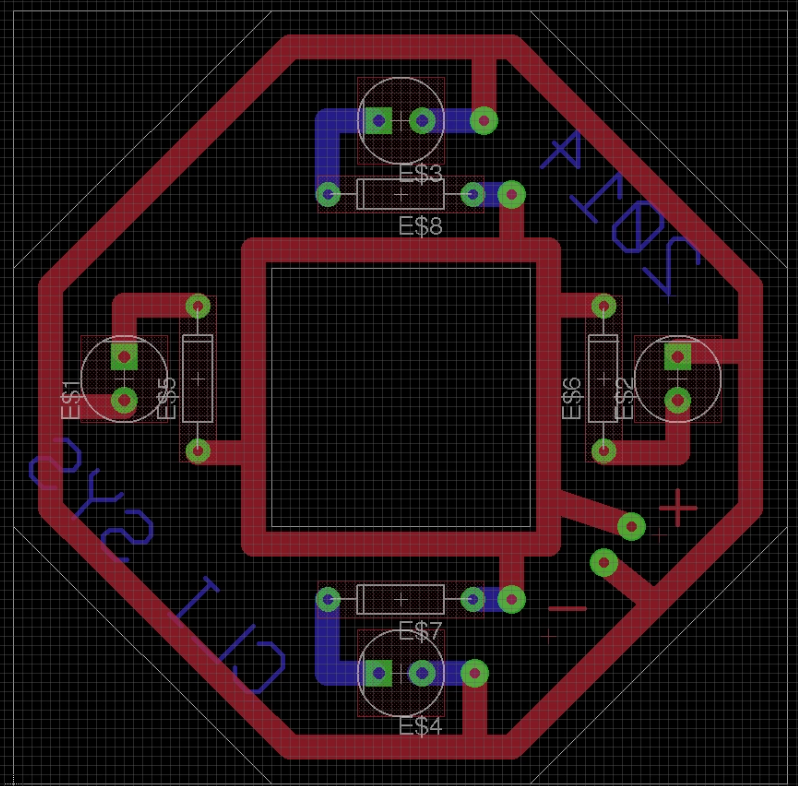
The dash on the car has very limited space so I separated the 7-seg from the control circuit.  Seperating the 7-seg the control circuit can be in a box away from the driver and the small display mounted on the dash.

Here are a few photos of the setup http://www.mybitbox.com/gallery/gallery.php?g=vt_circuit

And also a demo video of how the system works http://www.youtube.com/watch?v=dHIJK_iaXzc

For those interewsted in the code, here is a link to a ZIP of everything.  This code compiles on linux using gcc-avr and can be downloaded to an ATMega8 using a Dragon AVR USB programmer on Ubuntu if you have avrdude installed.  Also, here is a schematic of the final circuit.

Simple Breadboard Regulator PCB

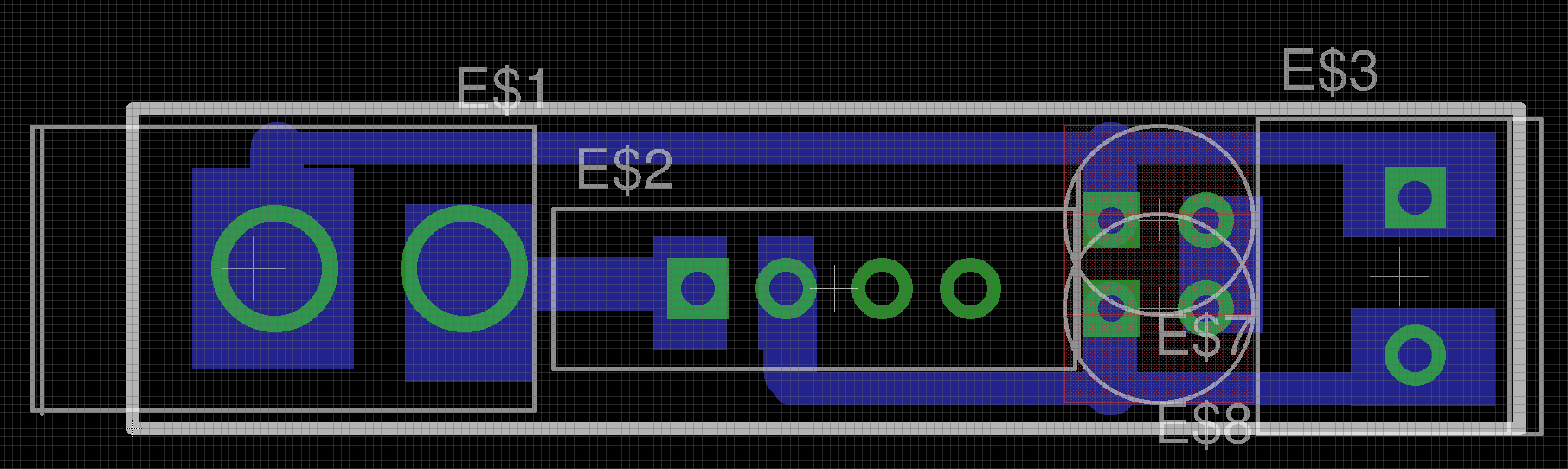
Simple breadboard regulatorI recently sat down with my new favorite Linux PCB program Kicad and developed a simple PCB for a 5V breadboard regulator.  The idea main goal for this PCB is not to develop the ultimate breadboard power supply but to learn Kicad and how to get a PCB done professionally.  I’ve done a bunch of DIY PCBs in the past with “eh” results, thus, this time I am going to get a PCB made professionally from BatchPCB.  BatchPCB is a spin off from SparkFun Electronics and combines small prototype orders into full pallet runs.  There is a few weeks lead time but if you can wait it looks like the best option for DIYers.

I’ve learned a lot about PCB design in Kicad by looking at personal sites and tutorials and wanted to share my Kicad project with others.  Here is a ZIP file with all the project files.  I also use a custom library for the parts and footprints (much easier than using pre-made ones, which usually don’t work)

http://www.mybitbox.com/browser/files/s1axter/simple_bb_reg.zip
http://www.mybitbox.com/browser/files/s1axter/kicad_libs/

Guitar amp project

Acrylic guitar ampAfter making the Standalone Voltage Regulator I decided to see what else could be made on one of the single IC boards from RadioShack.  About a year ago I built a mini-guitar amp using an LM386 audio amplifier and a small 8 ohm speaker from an old computer, you can see the post on geeksinside.com.  Since the LM386 only needs a few capacitors and a resistor I wanted to see if it can be crammed on to one of the boards.  After a bit of study the answer is yes!  This week I soldered the unit together and mounted it an acrylic box you can find at craft stores.  I plan on doing a write up like the regulator, with part numbers and part layout, however for now I have a gallery up showing the finished product.

Here is a short list of the parts I used, for the ambitious:

  • RadioShack single IC PCB
  • 100 uF electrolytic capacitor
  • 0.1 ceramic capacitor
  • 4.7 uF capacitor
  • 10 uF capacitor
  • 10 ohm resistor
  • 8 ohm speaker
  • 25 ohm potentiometer
  • 9v battery and snap
  • 1/4″ mono phono jack
  • LED

Here are a few links to simple amps using the LM386. LittleGem Amp CigarBox Amp

Standalone Voltage Regulator

Standalone Voltage RegulatorThis week I dug through my electronics box and realized one of those Dual General-Purpose IC PC Boards from RadioShack would hold a LM7805 and requisite Caps. and LED very nicely.  After a bit of soldering I had a working unit.  Rather than just keep my new unit to myself I did a detailed write-up on how you can make this standalone regulator using parts from RadioShack!

I am also excited to announce that I have partnered with C Code Systems to provide component kits for these boards!  While you can go to the store and get all the parts (any good hackers should already have most of them) C Code Systems has put together kits that include all the parts required for the project.  I think this would be great for an introductory soldering or electronics course! Visit the C Code Systems Product Page

Panoramic Photos

Its been a while since I have posted anything here!  As you can tell I’m not a real regular blogger but every now and then i get a little itch to do something.  Today I present you with a tutorial on how to make panoramic photos on Ubuntu 8.10!

I have a write up with an example here: http://www.mybitbox.com/articles/panoramic-photos-in-ubuntu/

Panoramic shot of a house

Take a look and make some cool pans!

Welcome to myBitBox v2

I’ve always made websites from the ground up, almost 100% coded by me.  However in this day in age, with SEO, trackbacks, feeds, subscriptions, spammers, etc… unless your entire job is to build and maintain a website, it’s damn near imposible.  That’s why I’ve decided to switch to running myBitBox on an established content mangement system.  I know you are all worried that I am going to drop PHP and making cool things but fear not, you can’t keep a crazy computer engineer down (or away from projects).

Actually I think having a more streamlined site will help promote getting more projects up since I don’t have to spend time fixing my site code :-P.

So here’s to you and the future

s1axter_beer

Esquire E-Ink code disassembled

Originally posted September 9th, 2008


I got the Esquire magazines today (2) and ripped one apart before even looking at the first page.  I have to say I’m a little  underwhelmed considering the E-Ink is only 2×5 inches and isn’t a matrix like I hoped :-(.  However that underwhelmedness lasted only a few minutes until I discovered the whole thing was controlled by a PIC16F629 and there are connections for an ICSP connector!

A little about the setup, like the post on the Make blog said there are two panels that change shapes and text black then white.  The top panel has 11 distinctly controllable cells with 4 blocks, 3 rectangles, “The 21st Century”, “Begins”, “Now”, and the space in between.  I read a little today on how eInk works and it doesn’t surprise me they made distinct blocks, an addressable matrix seems complicated.

Tonight after work I soldered some wires onto the controller and downloaded and disassembled the firmware.   I was a little surprised there was no Code Protection enabled. It’s all PIC asm so it’s going to take some time to decode/modify, however expect some different animation sequences.

Reading Esquire eInk controller

I’ve decided to not post the code since it is copyright to Hearst Media or the engineer who wrote it.  If you want to pull the firmware here’s how:

  • Get/borrow/make a ICSP programmer (parallel programmers will work, just lead out the Vdd,Vss,MCLR,CLK,DATA pins
  • Remove the battery since it is only 3v and most likely you will be using 5v
  • Hook up the programmer and read the HEX (Code protection is NOT enabled)
  • Disassemble the code using your software of choice (mine is PikDev and gpasm)

I uploaded a new album to the gallery with some photos, take a look: mybitbox.com/gallery/esquire_eink/

If you have any questions leave a comment here, on Geeksinside.com or talk to me on EFNet #geeksinside

Esquire E-Ink cover

So I guess the Esquire E-Ink issues came out a little earlier than I thought!  blog.makezine.com/archive/2008/09/esquire_eink_cover_hackin.html. Who knew the October issue would be release like September 8th!

I’ve been waiting for these issues since they were announced a few months ago.  For those who don’t know Esquire magazine has put an E-Ink section in the cover of their October magazine,  some people have already opend the cover and went over the guts.  Looks like the whole thing is run using a PIC16F629!  I am going to go pick one (or two) up and see what I can do with it!

Update and RBG lamp

So here is a little update.  After doing the trackbot I started to think of some other projects that I’ve been wanting to do for a while.  While there are HUNDREDS of ideas floating around up there, one was doable and would look really cool and that is an RGB lamp of some sort.  I remember seeing this project: www.electronics-lab.com/projects/games/005/index.html and really wanting to do it.  So last week I scoped out some PICs on the Microchip site that have PWMs and ordered some samples.  Also I got on ebay and bought a 3W RGB LED, and here is the best part…I had a paypal gift card so it didn’t cost anything, always a plus  For those less fortunate the LED is ~$10, kinda like this EBay Listing.

Today I got my PICs, one each of 16F737, 18F2220, 18F2680 and 16F88.  They should work with my linux based setup.  I’ll post some pics of the setup soon but if you want to just know the facts I am using Ubuntu 8.04 with PikDev (pikdev.free.fr/), gputils (gputils.sourceforge.net/) which can be installed via Synaptic, and my P16PRO knockoff parallel programmer (geeksinside.com/view/180/Parallel-Pic-Programmer/).  The dev is done in assembly right now, but that’s why I got the PIC18Fs, so I can try out the PikDev C compiler and maybe even SDCC (sdcc.sourceforge.net/).

That’s it for now, I plan on making myBitBox a real personal blog, so check back!

Update (Sept. 3rd): I started a gallery of the RGB Lamp, I plan on updating it over time.  Here it is: Http://mybitbox.com/gallery/rgb_lamp/

TrakBot

Last week I picked up a Tamiya tracked vehicle cassis from a hobby store to use as a mobile platform.  http://www.superdroidrobots.com/shop/item.asp?itemid=484

Sunday and Monday I put it together and canibalized my old Hookbot for the H-Bridge, gearboxes and PIC.  I used the Tamyia dual gearbox drive rather than the one that came with the chassis because any good robot can turn, not just go forward and reverse; hey maybe I’ll use the single motor for a turret!  Anyway the brains are a PIC 16F872 and the H-bridge is a SN754410.  The drive motors are power by three AA batteries for ~4.5volts and has a bit of acceleration and power, I am quite impressed.  Right now the H-bridge gets a little warm when the motors are strained.  I am going to have to do some tests and see how hot it gets on carpet running for a few minutes.

web_100_0474

Here are some pics!: http://mybitbox.com/gallery/trak_bot/

Old Hookbot code (pretty much the same): http://mybitbox.com/files/s1axter/hookbot.asm

And a Video: http://www.youtube.com/watch?v=CJphi2-PTYU

WordPress Themes